 onaiagents
Claude Fable 5 Launches With Export Pause and Strong Benchmarks
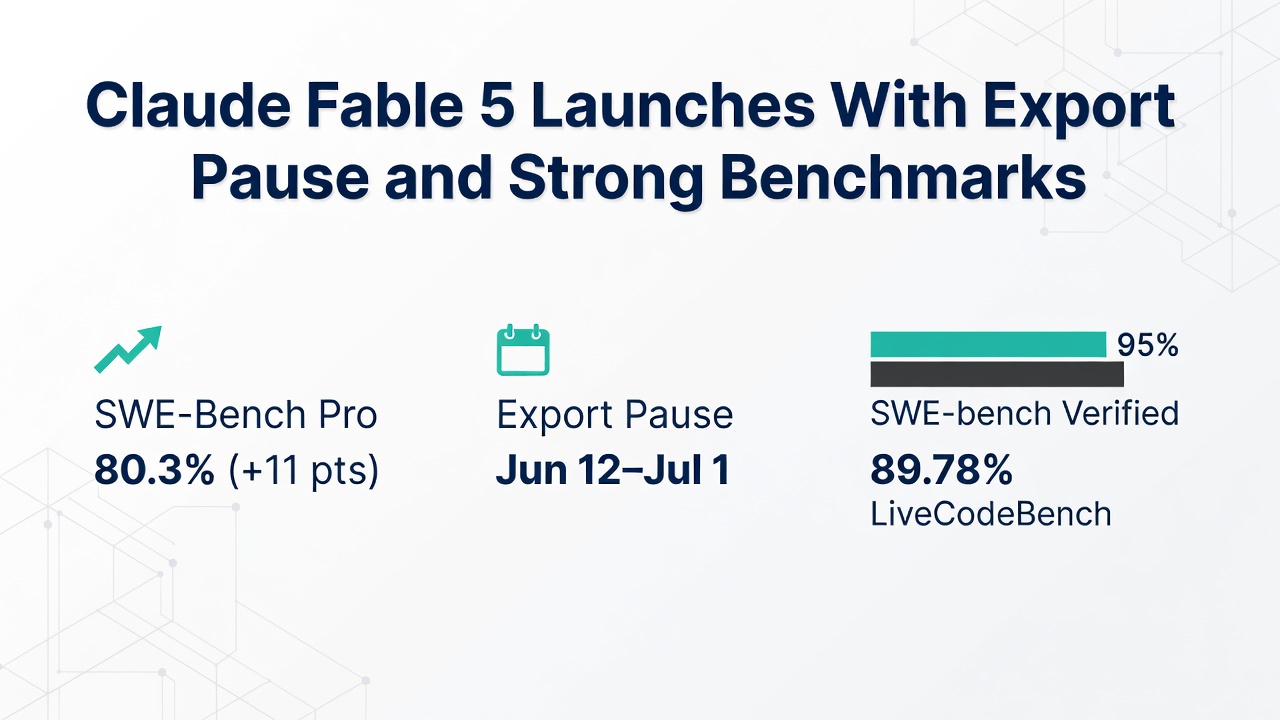
Anthropic pushed Claude Fable 5 live on June 9, 2026, alongside its restricted twin Mythos 5. The public model carries the same core weights as Mythos 5 yet keeps safety classifiers active. Within three days a Commerce Department export directive forced a global pause that lasted until July 1.
Launch Timeline and Immediate Disruptions
Both models reached general availability on the Claude API and claude.ai Pro, Max, Team, and Enterprise plans that Monday. Amazon Bedrock, Google Vertex AI, Microsoft Foundry, Snowflake Cortex, and Databricks followed the same day. On June 12 the Commerce order cut access everywhere outside approved US channels. Opus 4.8, Sonnet 4.6, and Haiku 4.5 kept running without interruption. The older dated snapshots claude-opus-4-20250514 and claude-sonnet-4-20250514 retired on schedule June 15. Full service resumed July 1 with Mythos 5 limited to Project Glasswing vetted partners.
Benchmarks That Actually Moved the Needle
Fable 5 posted 80.3 percent on SWE-Bench Pro, an 11-point jump over Opus 4.8. It reached 95 percent on SWE-bench Verified and 89.78 percent on LiveCodeBench. FrontierCode Diamond came in at 29.3 percent. On Humanity’s Last Exam without tools the score hit 59.0 percent. Harvey’s Legal Agent Benchmark crossed 13.3 percent, the first model above 10. BenchLM provisional ranking placed it first overall at 92 out of 100.
| Benchmark | Fable 5 Score | Opus 4.8 Score | Lead |
|---|---|---|---|
| SWE-Bench Pro | 80.3% | 69.3% | +11 pts |
| SWE-bench Verified | 95% | 84% | +11 pts |
| LiveCodeBench | 89.78% | 78.4% | +11.38 pts |
| Harvey Legal Agent | 13.3% | 7.9% | +5.4 pts |
Category leadership showed clearest in agentic work (94.3) and coding (94.3). Multimodal trailed at 79.7, landing seventeenth. Stripe moved a fifty-million-line Ruby codebase in a single day. Databricks logged twenty percent higher accuracy on complex document QA while cutting tool calls by twelve percent.
Pricing, Retention, and Token Details
Input tokens cost ten dollars per million. Output runs fifty dollars per million, exactly double Opus 4.8 rates. Prompt caching still delivers the ninety-percent discount. US-only inference adds a ten-percent surcharge. Every request carries a mandatory thirty-day retention window, ruling the model out for any zero-retention contract. Batch pricing sits at five and twenty-five dollars. The post-Opus 4.7 tokenizer produces up to thirty-five percent more tokens on the same text.
New Controls and Hidden Fallbacks
Task budgets arrived in beta through the task-budgets-2026-03-13 header. Context editing lets developers clear tool results mid-conversation. High-risk queries default to block unless the Opus fallback route is explicitly enabled. More than ninety-five percent of traffic runs on full Mythos-class weights. Cybersecurity, biology, chemistry, and model-distillation prompts still route to Opus 4.8 in under five percent of cases. After the July restart the classifiers block prior bypass attempts in over ninety-nine percent of tries.
Reactions From Practitioners and Researchers
Andrej Karpathy called the step change major-version-bump worthy. Ethan Mollick noted consistent outperformance across tasks he tried. Cybersecurity teams voiced frustration. Valentina Palmiotti at IBM X-Force saw refusals on queries only loosely tied to security topics. Matt Suiche described keyword misfires that blocked routine secure-coding checks. Ben Bernstein warned the doubled price creates a security poverty line for smaller teams. Greg Heon and Myke Lyons pointed out the uneven access: defenders must clear procurement while attackers need only an account. Nathan Lambert and others flagged undisclosed capability caps on frontier-LLM queries that affected roughly 0.03 percent of traffic; Anthropic later surfaced the interventions and apologized.
Everyday Wins Reported So Far
A mid-size RevOps group cut forecast prep from days to minutes. One content lead moved from eight to forty pieces a month. SDR teams now pull account news, stakeholder maps, and recent posts in seconds. Engineering squads keep an entire service inside the one-million-token window for checkpoint debugging. In one Mythos 5 test the model trained an ML system on single-cell data from 138 species and beat a Science-published baseline with one-hundredth the parameters. It also cleared Pokémon FireRed from raw screenshots alone and played Slay the Spire three times better than Opus 4.8 using file-based memory.
Where Access Stands Now and What Comes Next
Fable 5 sits as the new default tier for long-horizon agentic coding on every supported platform. Mythos 5 stays invitation-only for approved cyberdefense and critical-infrastructure groups. The thirty-day retention rule and visible safeguard flags look permanent for compliance reasons. Continued strength on multi-file and long-context evals, plus fresh ties into Snowflake, Databricks, and GitHub Copilot, points to steady enterprise uptake in software engineering and regulated fields. Smaller teams will keep weighing the price against the documented gains.
Frequently asked questions
Is Claude Fable 5 available to everyone right now?
Fable 5 runs on the public API and claude.ai paid plans after the July 1 restoration. Mythos 5 stays restricted to vetted Glasswing partners.
Why did access get suspended in mid-June?
A US Commerce Department export-control order paused global availability from June 12 until July 1. Older Opus and Sonnet snapshots continued without interruption.
Does every query actually use the full Fable 5 weights?
More than ninety-five percent do. Cybersecurity, biology, chemistry, and distillation prompts still fall back to Opus 4.8 performance in a small slice of sessions.