 onaiagents
Giving NVIDIA APIs Real Tool Access for Agents
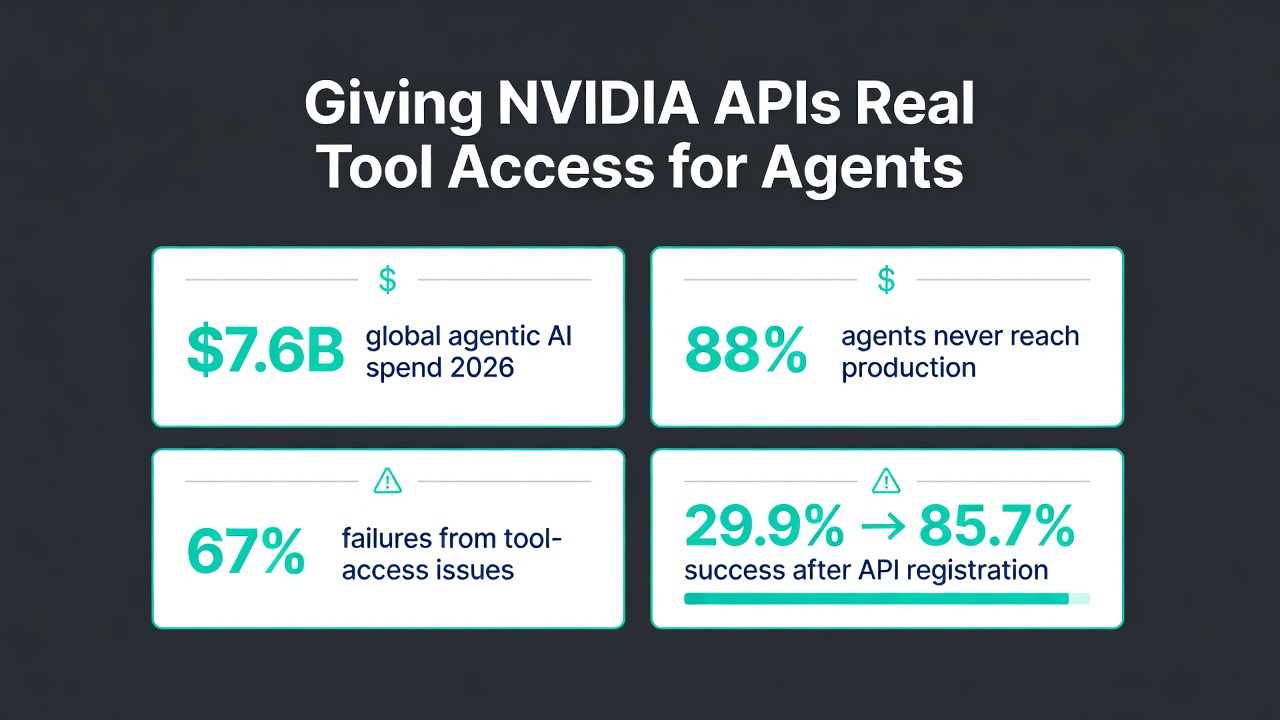
Most teams hit the same wall once they move past simple chat: the agent can reason but cannot reliably use the actual tools or APIs it needs. NVIDIA’s stack gives you fast inference through NIM and structured workflows through NeMo, yet the connection layer between agent and external system remains the weak point. The numbers tell the story. IDC projects global agentic AI spend at $7.6 billion in 2026, yet 88 percent of agents never reach production and 67 percent of those failures trace back to governance or tool-access problems.
The core requirement: turning APIs into agent-ready functions
NVIDIA packages inference as NIM microservices and adds NeMo microservices for data prep, evaluation, guardrails, and retrieval. Both ship as Docker containers on Kubernetes. The NeMo Agent Toolkit then treats every tool as a registered function call that LangChain, CrewAI, or LlamaIndex can invoke. Without that registration step, you are left feeding raw OpenAPI specs to the model. xpander AI tested the difference on HubSpot tasks and recorded 29.92 percent success with plain specs versus 85.65 percent once the interface was enriched through multi-agent pipelines.
Where raw model speed stops mattering
Blackwell B200 systems now deliver roughly five times lower cost per million tokens on large open models. GB300 NVL72 racks hit 2.5 million tokens per second on DeepSeek-R1 in MLPerf Inference v6.0. Those gains are real, but they only help once the agent can call the right tool at the right moment. Jensen Huang has been explicit: agents that touch sensitive data or external systems cannot run without controls. That is why five security vendors released integrations at the same time as the latest NVIDIA releases, with CrowdStrike covering four enforcement points inside the stack.
Practical registration paths that teams actually use
AgentIQ registers third-party tools through standard Python entry points. You point the package at aiq.plugins.agno.register and the function becomes visible to the agent runtime. LangSmith tracing and FastMCP publishing come included. Cloudera Agent Studio adds four orchestration layers on top of the same NVIDIA foundation: dynamic multi-step planning, transparent agent collaboration, context engineering that trims token waste, and sandboxed execution that keeps privilege boundaries intact. One free way to do this is Agent Studio.
Real deployments that moved past the 88 percent failure line
AT&T and its partners built an agent that ingests nearly ten thousand updated documents every week using NeMo microservices. Eclipse Automation used a NIM Agent Blueprint for robot fleet simulation and cut design time by half while trimming cycle time 30 percent. Cadence, Dassault Systèmes, Siemens, and Synopsys each run autonomous engineering agents on NemoClaw blueprints. Wipro runs claims agents for a major U.S. health insurer and fraud agents for banks on the same HPS platform. These examples share one pattern: they added structured tool registration and sandbox controls instead of relying on inference speed alone.
Common shortcuts that keep agents out of production
| Approach | Observed success rate | Primary failure mode |
|---|---|---|
| Raw OpenAPI spec passed to model | 29.92 percent | Missing context, malformed calls |
| Enriched multi-agent interface | 85.65 percent | Still needs sandboxing |
| NIM inference only, no NeMo layers | Low long-term retention | No evaluation or guardrails |
| Full NeMo + AgentIQ stack | Highest in reported cases | Requires initial setup time |
Skipping context engineering inflates token counts and drops accuracy on anything longer than a few steps. Assuming benchmark gains on MMMU or GPQA will carry over to tool calling ignores the 67 percent governance failure rate. Running without sandboxed runtimes exposes the exact risks Huang warned about.
Security and governance realities in 2026
Forty-eight percent of cybersecurity professionals now rank agentic AI as the top attack vector for the year, yet only 29 percent of organizations feel prepared. Machine identities already outnumber human ones 82 to 1 inside large environments. The five-vendor security framework announced alongside the NVIDIA stack addresses this by embedding controls at the model, endpoint, cloud, and identity layers. Deployments that ignore these controls stay in the 88 percent failure bucket.
What actually moves the needle now
The performance numbers on Blackwell and the Nemotron 3 Ultra 5x inference gains are table stakes. The differentiator is the integration layer that turns an API into a reliable, auditable function the agent can call inside defined boundaries. Teams that register tools through the NeMo Agent Toolkit or AgentIQ, add context engineering, and enforce sandbox execution are the ones shipping agents that survive contact with real data and real systems. Everything else stays in the pilot graveyard.
Frequently asked questions
Do I still need NeMo microservices if I already run NIM inference?
Yes. NIM handles fast inference. NeMo supplies the data preparation, evaluation, guardrails, and tool registration that turn an inference endpoint into a production agent.
What success rate should I expect with raw OpenAPI specs?
Tests on common enterprise tasks show roughly 30 percent success. Enriched interfaces that add context and validation push results above 85 percent.
How do I keep agents from accessing data they should not touch?
Use the sandboxed execution and privilege boundaries built into platforms like Cloudera Agent Studio or the security integrations released with the NVIDIA stack.