 onaiagents
Grok Aurora Using the New Image Model on Site
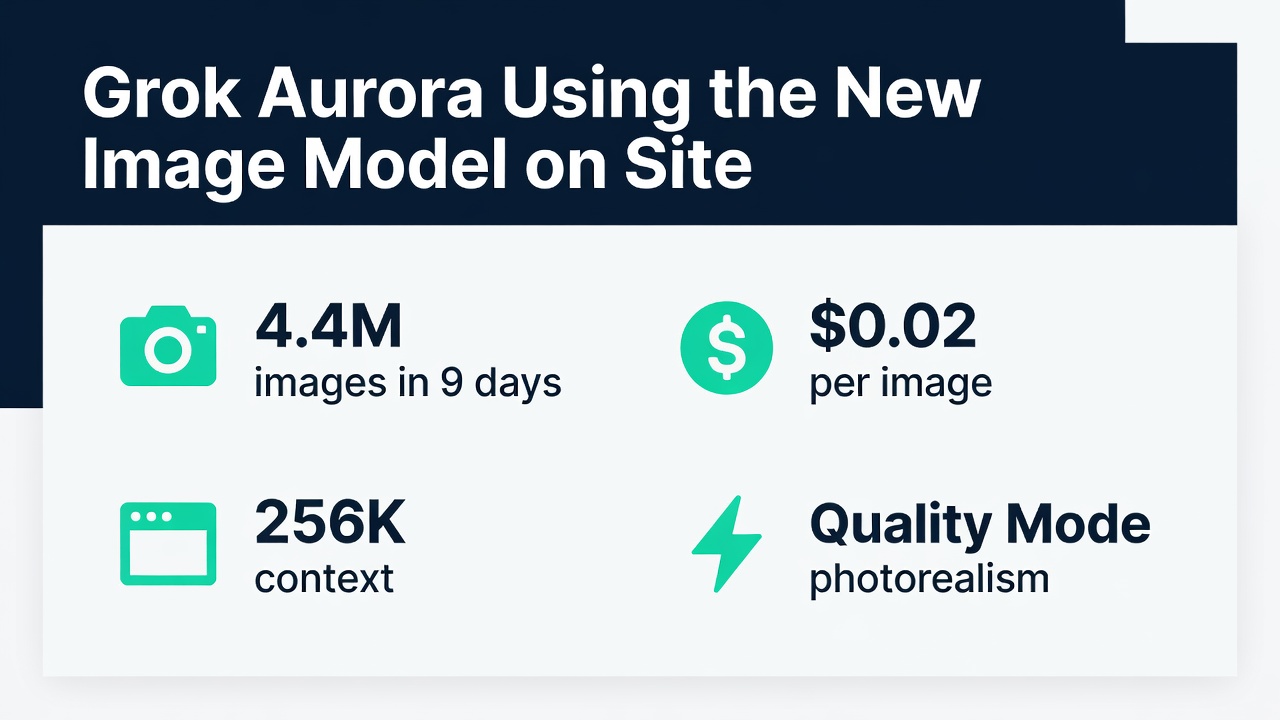
xAI shipped Aurora, its autoregressive mixture-of-experts image model, after training on billions of internet image-text pairs. The release landed with Grok Imagine on X and the public API, and the numbers moved fast: 4.4 million images generated in nine days during one January stretch, followed by over a billion videos the same month once video endpoints opened.
Aurora's Core Capabilities
The model takes interleaved text and images as input and predicts the next token, which lets it do text-to-image, image editing, and direct inspiration from an uploaded photo in one pass. xAI claims state-of-the-art results on photorealism, logo accuracy, and human portraits. Independent checks place Grok 4.3 at rank 37 on the Artificial Analysis index, so the marketing claims sit beside measurable but not dominant scores.
Two modes matter for production work. Quality Mode sharpens textures, fixes lighting, and renders legible text better than Speed Mode. The difference shows up immediately on fine details like product labels or signage. Native multimodal input already accepts user images for editing; that feature reached X users shortly after the initial announcement.
How the API Works for Image Tasks
The xAI API stays OpenAI SDK compatible, so most existing clients need only an endpoint swap and key. Text-to-image calls cost $0.02 per image. Image editing sits at $0.022 per image. Both return results in seconds for typical prompts. You can chain an image output straight into a follow-up edit call without leaving the same session.
Multimodal sessions benefit from the 256K context window available through the API (the app caps at 128K). That matters when you keep several reference images in one conversation for consistent branding. Grok 4.3 later added native video input and in-chat document generation, but the image endpoints stayed stable from the January launch onward.
Cost Breakdown and Rate Limits
Free X access limits users to roughly ten requests every two hours. Paid tiers remove that ceiling: SuperGrok at around $30 per month and the Heavy plan at $300 unlock higher throughput plus Grok 4 Heavy multi-agent routing. Enterprise contracts add compliance controls for branded output.
| Endpoint | Price | Notes |
|---|---|---|
| Text-to-image | $0.02 per image | Standard quality |
| Image editing | $0.022 per image | Multimodal input supported |
| Video 1.0 (720p) | $0.07 per second | 10-30 second clips |
| Video 1.5 Fast | ~25 seconds per clip | Consumer tier option |
Those figures come straight from the January API pricing sheet. Video 1.5 later introduced a selectable Quality Mode that trades extra compute for sharper output.
Building Website Features with These Models
Start with a simple upload form that sends the image and prompt to the edit endpoint. Store the returned URL and metadata in your own database so you can offer users folders for organizing generations, a feature xAI added in early March. For product pages, feed a base product shot plus a style prompt to create variations without manual Photoshop work.
Game asset pipelines already chain Aurora image output into image-to-video calls for quick animation tests. The same pattern works on marketing sites: generate a hero image, then extend a short motion version for hero video if the use case justifies the extra cost. One free way to handle the motion side is to route the still through a tool like Video Studio that calls the same grok-imagine-video backend.
Keep an eye on context length when users upload multiple reference shots. The 256K window lets you maintain brand consistency across a full product catalog page without dropping earlier images.
Performance Benchmarks Worth Paying Attention To
Grok 4.3 scores include 95 on AIME, 88 on GPQA, and 75 on SWE-bench. On Humanity’s Last Exam it reached 38.6 percent with tools, climbing to 44.4 percent in Heavy mode. Image-specific claims rest on internal testing; no first-party Grok 4.3 image benchmark suite has been released yet. Latency sits at a median 1.8 seconds with 99 percent of requests finishing inside 6.8 seconds.
Training details show two-thirds of Grok 4 compute went to reinforcement learning. That focus helps instruction following but does not eliminate the quality drop when chaining many “Extend from Frame” operations on the video side.
Handling Video Extensions Alongside Images
Video 1.0 outputs native 4-megapixel clips up to 30 seconds. The March “Extend from Frame” tool continues a clip from its final frame, useful for branded sequences. Quality degrades after several extensions, a limitation xAI has not fixed in public releases. Keep chains short if you need consistent fidelity.
Enterprise teams use Folders to organize these longer assets at scale. The same compliance flags that apply to image output carry over to video, which matters for any site serving regulated industries.
What Teams Get Wrong in Practice
Early users hit misuse flags when image generation sat behind an open endpoint. The paid-subscription gate arrived in January after reports of problematic content. Free-tier rate limits still bite high-volume sites that forget to monitor usage. Ignoring the 128K versus 256K context difference truncates long editing histories and breaks consistency.
Assuming open-weight versions exist is another common error. All Aurora endpoints remain proprietary. Over-reliance on repeated frame extensions produces visible artifacts that surface only after the asset reaches production.
Regulatory pressure continues. By March 2026, EU and UK authorities plus 37 U.S. state attorneys general had flagged deepfake risks, and a lawsuit involving teenagers and explicit generated images had already been filed. Any website integration needs clear moderation layers.
The infrastructure behind Aurora runs on 110,000 NVIDIA GB200 GPUs inside Colossus. That scale supports the rapid release cadence xAI has kept since 2023, with major versions landing every five to eight months. Grok 5 remains the next open question as of April 2026.
Frequently asked questions
Can I call the Aurora image endpoints without an X subscription?
Yes, through the xAI API directly. You need an API key and will pay per call regardless of X tier.