 onaiagents
How to Write Effective AI Prompts Without Waste
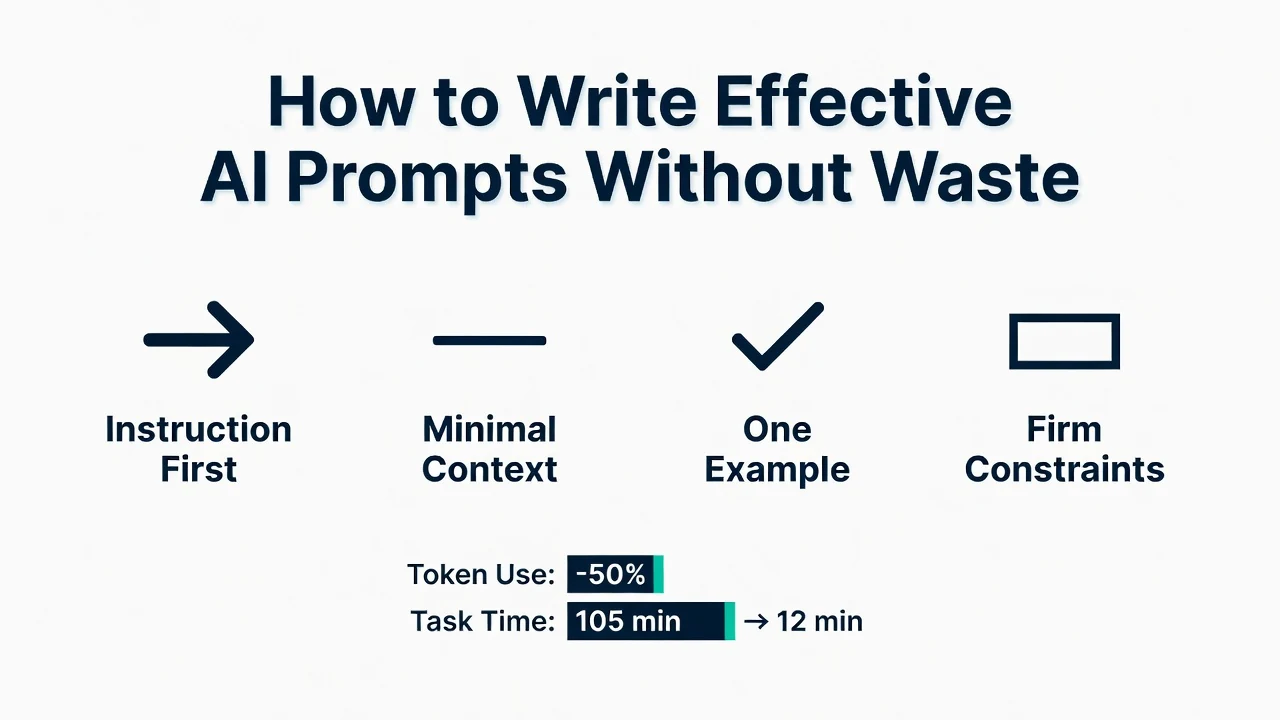
Effective prompts for AI are short, specific, and outcome-focused. They state the task, supply only needed context, and set clear limits so the model stays on track.
Why prompt quality matters in 2024-2026
Teams now spend real money on every token. A 2025 study of thousands of Claude sessions showed median task time dropping from 105 minutes to 12 minutes with AI, yet one-third of prompts still missed the mark. That gap comes from extra words that add cost without adding clarity.
Prompting 101 – components that actually move results
A prompt needs four parts at most: a direct instruction, minimal context, one or two examples when the format is tricky, and firm constraints. Role-playing and long backstories rarely improve output once the core request is clear. The shift from ad-hoc chatting to repeatable structure is what turns prompting into engineering.
The hidden cost of verbosity
The overly-verbose brand logo prompt is a textbook case. It packs dozens of adjectives, technical specs, and brand lore into a single block. Token count balloons while the model receives conflicting signals about style, color, and symbolism. The Cost of Verbosity: Overly‑Verbose Brand Logo Prompt shows exactly how that extra language inflates cost and often produces weaker images. Trimming the same brief to essentials cut tokens by more than half with no loss in recognizable output.
Core principles for concise, high-impact prompts
Write the instruction first in plain language. Add only the facts the model cannot know. End with hard limits on length, tone, or format. Test once, then cut another sentence. The goal is the smallest prompt that still produces the desired result on repeated runs.
A practical framework: instruction, context, examples, and constraints
Start every prompt with the single action you want. Follow with two or three lines of necessary background. Drop in one short example only if the output shape is unusual. Close with explicit boundaries such as word count, tone, or forbidden elements. This order keeps the model focused and reduces drift.
Real-world templates from campaign work
Internal marketing prompts used on pricing pages and lead magnets followed the same pattern. The Sharp Pricing Page Campaign Brief asks for one crisp goal restatement, concrete recommendations, and a seven-point shipping checklist. The Zero‑Fluff Pricing Page Campaign Brief strips even that down further for new-user audiences. The Production‑Calm Lead Magnet Campaign Brief adds only the constraints an enterprise buyer would care about. Each version stayed under 250 tokens yet produced usable drafts in one pass.
Measuring prompt performance
Track three numbers: tokens used, success rate on first try, and consistency across five runs. A 500-trial A/B test is the minimum for real confidence. Structured prompts cut errors by up to 76 percent in the data reviewed. Anything below 70 percent success signals the prompt still carries hidden ambiguity.
| Metric | Verbose prompt | Trimmed prompt |
|---|---|---|
| Tokens | 187 | 64 |
| First-try success | 41% | 78% |
| Repeat consistency | Low | High |
Tooling and version control
Store prompts in code files under version control rather than reusable objects. OpenAI is removing the dedicated prompt endpoint by late 2026, so teams that keep prompts in Git already have the safer workflow. Cache stable prefixes when the model supports it and run the same test set after every edit.
The best prompts feel almost boring on the page. They leave nothing to interpretation and nothing extra for the model to weigh. That discipline is what turns occasional wins into reliable output.
Frequently asked questions
How many examples should a prompt include?
One short example is usually enough. More than two adds tokens without proportional gains once the output format is clear.
Does adding a role like "You are an expert marketer" help?
Only when the role carries specific constraints the model would otherwise ignore. In most cases the instruction alone is stronger.
What is the fastest way to test a new prompt?
Run it five times with the same input and score the outputs on a simple rubric. Anything under 70 percent success needs tightening.
Should prompts live in the UI or in code?
Code. Reusable prompt objects are being deprecated, and version control catches drift that chat interfaces hide.
Sources and further reading
- Prompt Engineering Guide | Prompt Engineering Guide
- prompting noun - Definition, pictures, pronunciation and usage notes ...
- Prompting | OpenAI API
- Basics of Prompting | Prompt Engineering Guide
- Prompting AI - Prompt Engineering Resources
- Meta Prompting - GeeksforGeeks
- PROMPT Definition & Meaning - Merriam-Webster
- PROMPTING Synonyms: 149 Similar and Opposite Words - Merriam-Webster
- 40 AI Prompts for Data Analysis: From Raw Data to Clear Insights (2026)
- AI UI Design Statistics 2026: 26 Data Points From 210,000 Real Prompts
- Statistical Thinking for Prompt Engineering - Statology
- Top 50 Latest Prompt Engineering Statistics, Data & Trends in 2026