 onaiagents
Multi-Agent AI in Real Enterprise Workflows
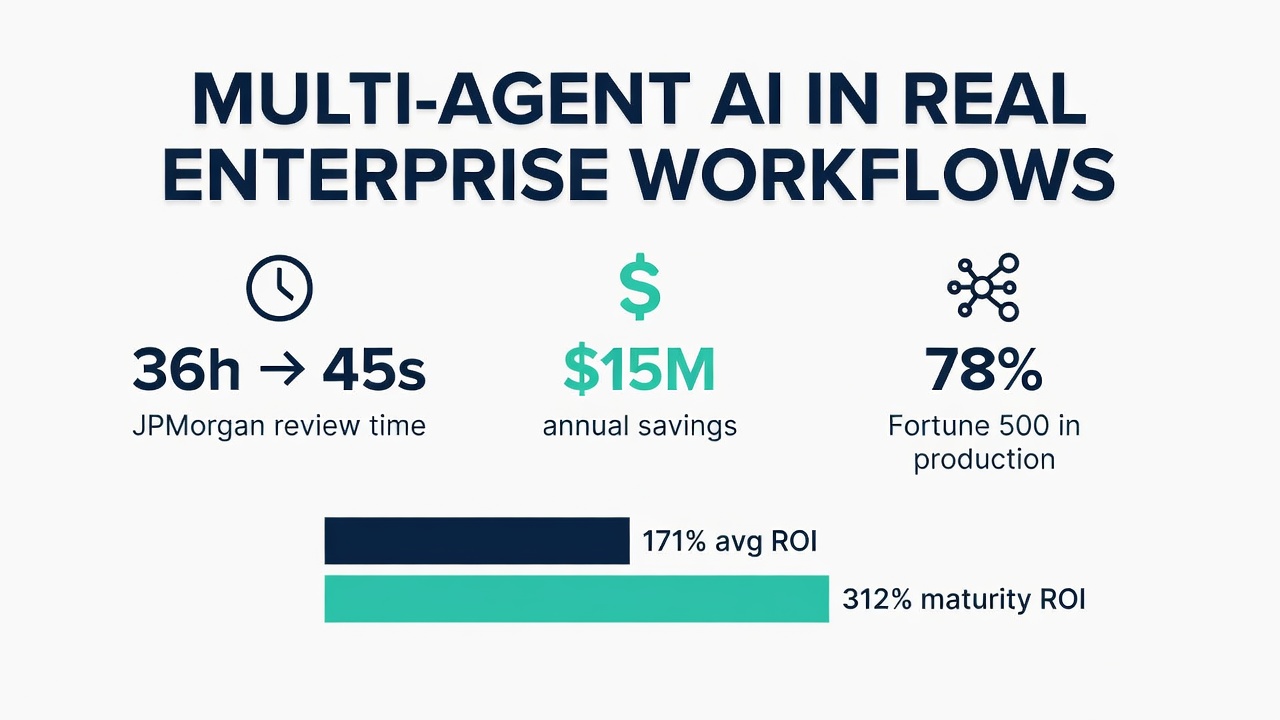
JPMorgan cut credit agreement review from 36 hours down to 45 seconds with its COiN platform and saved $15 million a year. That kind of result now shows up across industries when teams move from single agents to orchestrated groups. The shift brings new questions about which frameworks hold up under load and which patterns actually scale without constant babysitting.
The move from demos to live multi-agent teams
LangGraph, CrewAI, LangChain, and AutoGen were each tested on the same five-agent travel-planning job one hundred times. Every run finished. LangGraph used the fewest output tokens at 2,589 and ran 2.2 times faster overall than CrewAI. CrewAI added a nine-second delay in the Flight Finder step plus another five seconds waiting on tools, while the other three frameworks triggered tools almost immediately. Agents without tools settled into a steady six-to-eight-second range across all four frameworks.
AWS recently added a supervisor agent in Bedrock that breaks tasks apart, hands them to specialist agents, and pulls results together. Reference setups pair it with LangGraph or CrewAI. Three main patterns dominate: one central supervisor, direct peer messaging, or layered hand-offs. Most teams still default to Python, though custom stacks appear when the workflow does not fit standard templates.
Adoption numbers that matter right now
Market estimates for 2024 sit between $2.9 billion and $5.25 billion, with forecasts stretching to $48 billion or even $199 billion by the early 2030s depending on the source. Gartner expects agentic features inside 33 percent of enterprise applications by 2028, up from under 1 percent in 2024. McKinsey found 62 percent of organizations experimenting and 23 percent already scaling by late 2025. Seventy-eight percent of Fortune 500 companies now run at least one agent in production.
PwC data shows 79 percent of organizations have some agent implementation, though only 19 percent operate at scale. Average projected ROI lands at 171 percent, rising to 192 percent for U.S. firms. Teams that follow a maturity model reach 312 percent ROI inside 18 months; ad-hoc efforts stall at 87 percent. Forty-three percent of companies now direct more than half their AI spend toward agent work, yet 75 percent list governance as the top blocker and over 40 percent of projects carry cancellation risk by the end of 2027.
Measured performance differences across frameworks
The token spread on that travel workflow was wide: CrewAI finished at 5,339 tokens while LangGraph stayed at 2,589. Latency gaps compound when teams run thousands of tasks daily. GraphBit’s Rust core aims at deterministic speed for high-volume use, and protocols like Google’s A2A are being discussed for cross-framework hand-offs.
State handling still leans on MemGPT, LangMem, or simple shared scratchpads. Fault tolerance requires idempotent steps, graceful degradation when one agent drops, and guards against loops that burn tokens. Evaluation suites that test coordination, tool use, memory, and control are now standard before any rollout passes four or five steps.
Concrete results from live deployments
Siemens built an Eigen Engineering Agent inside TIA Portal that serves more than 600,000 users. Pilot customers report up to 50 percent higher engineering efficiency and two-to-five-times faster execution. The same company’s supply-chain agents cut disruption detection from 72 hours to 15 minutes and trimmed delays by 34 percent.
Salesforce Agentforce handled over 50 million tickets autonomously, moving resolution time from 8.2 hours to four minutes and lifting CSAT from 3.2 to 4.6. A healthcare intake agent runs at eight cents per interaction against $4.20 for a human while holding 94.3 percent accuracy. Fraud detection agents reach 96.8 percent accuracy at two-tenths of a cent per transaction.
Where projects go off track
Teams often start with decentralized messaging when a single supervisor would be simpler to debug. CrewAI and AutoGen can ship quickly for prototypes, yet both need extra work on reliability and loop prevention before production. Skipping dedicated evaluation frameworks leaves coordination issues hidden until volume rises.
Token and latency variance gets ignored until bills arrive. One example showed 1,000 seats purchased against only 287 active users, with overlapping tools creating $500,000 to $2 million in annual waste. Ad-hoc rollouts consistently underperform maturity-framework approaches by a wide margin on ROI.
LeCun’s view on current limits
Yann LeCun argues that today’s large language models remain pattern matchers without genuine understanding or common-sense world models. He points out that frontier models train on roughly 10^14 bytes, about the visual input a four-year-old receives, yet produce none of the physical competence humans show by that age. He sees scaling as an expensive detour with a three-to-five-year horizon and expects these systems to become largely obsolete within five years.
LeCun favors Joint-Embedding Predictive Architectures that learn by predicting latent states from video and other high-dimensional data. He left Meta to start Advanced Machine Intelligence Labs focused on robotics, industrial control, and autonomous systems. His public stance rejects 2025 superintelligence timelines and pushes research toward architectures that combine perception, memory, and planning beyond text alone.
Deployment choices that hold up
Centralized supervision tends to win for first production runs because it keeps debugging straightforward. Kubernetes pods, service meshes, Kafka for messaging, and etcd for shared state form the usual backbone. All major frameworks accept the OpenAI JSON schema for tool calls. Bedrock agent creation needs only a name, model identifier, and instruction string.
Start with a clear maturity path rather than scattered experiments. Track actual usage against purchased seats. Build evaluation into the pipeline so coordination failures surface early. Governance questions—cost controls, audit trails, fallback behavior—need answers before volume grows.
What comes next
Graph-based and supervisor patterns are converging as the practical default. At the same time, research momentum is shifting toward systems that move past pure language scaling. The gap between current production wins and longer-term architectural change is real, yet the immediate results in cost, speed, and accuracy keep teams shipping multi-agent setups today.
Frequently asked questions
Which framework showed the lowest token use on the travel workflow test?
LangGraph used 2,589 final output tokens, the lowest among the four frameworks tested on identical runs.
What ROI difference appears between maturity-framework and ad-hoc deployments?
Maturity-framework teams reached 312 percent ROI inside 18 months while ad-hoc efforts averaged 87 percent.
How many Fortune 500 companies run at least one agent in production?
Seventy-eight percent now have at least one agent live, up from 35 percent the prior year.